
Rooted in history: Jesse Owens Olympic oak saplings auction benefits Black Equity and Humanity Fund







At the 1936 Olympic Games in Berlin, the German Olympic Committee gifted English oak saplings to gold medalists after the Olympic Games.
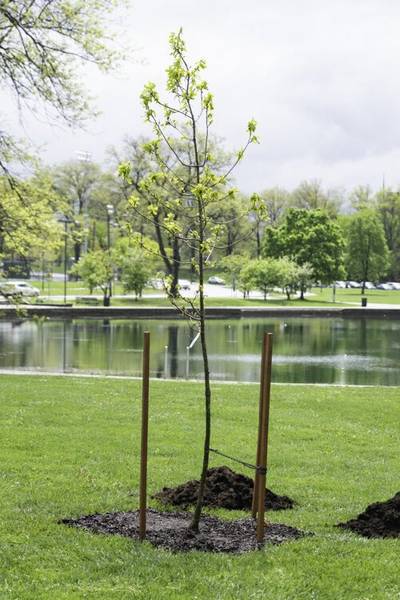
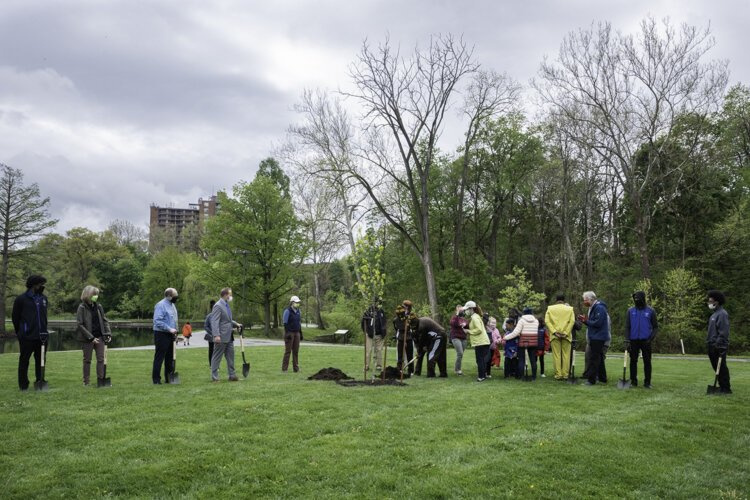
 A newly-planted Jess Owens oak sapling clone planted at Rockefeller Park in 2021.The national trees of Germany were presented in pots adorned with the Olympic bell and the inscription, “Wachse zum Ruhm des Sieges! Mahne zu weiteren Taten!” (Grow to the honor of victory! Summon to further achievement!)
Cleveland track and field star Jesse Owens returned to the United States with four saplings, each medal representing one of the four gold medals he won under the hateful gaze of Adolf Hitler and the Nazi regime.
Upon Owens’ return to Cleveland, the saplings were planted at James Ford Rhodes High School, where Owens trained; at East Tech High School, where Owens attended secondary school; The Ohio State University, where Owens attended post-secondary school (the location of the tree is not confirmed); and the front yard of the house that Owens bought for his parents in Cleveland.
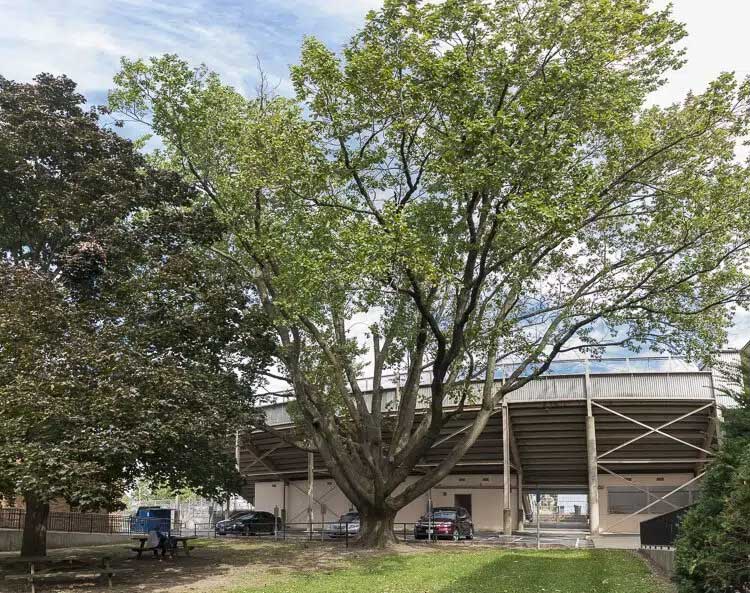
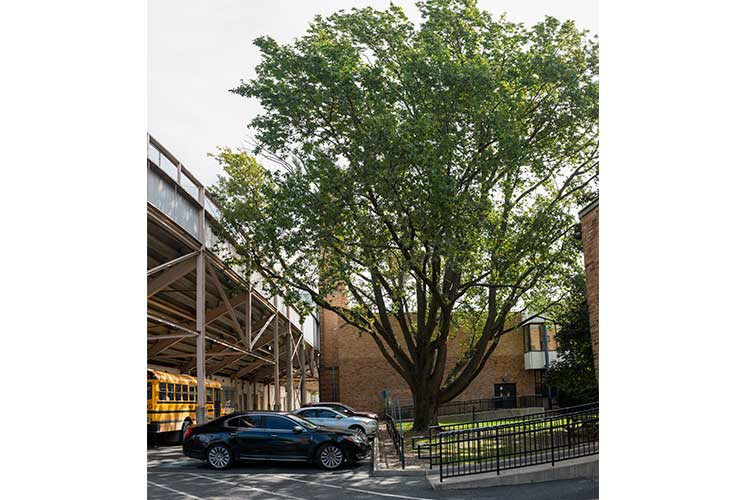
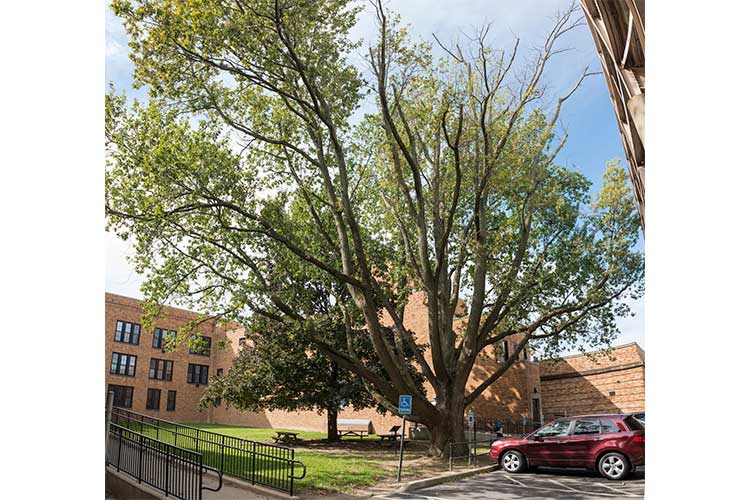
The original four English oak trees were lost to time—with the final surviving tree at Rhodes High School succumbing to old age in 2022.
However, Holden Forests & Gardens in 2017 worked with several organizations to successfully clone saplings from the Rhodes tree to preserve Owens’ Cleveland legacy and place in history.
The sapling clones from the Jesse Owens oak at Rhodes High School have been planted at Rockefeller Park in University Circle and Rhodes High.
Additional cloned saplings were recently auctioned during a week-long event honoring Owens and promoting racial equity.
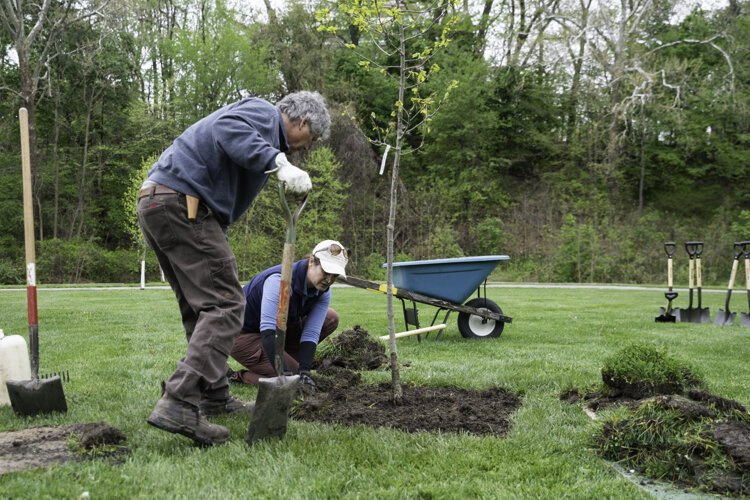
 The new sapling planted next to the original Jesse Owens tree planted 86 years agoLed by the Cleveland Black Equity and Humanity Fund, the private auction culminated in a community celebration on Saturday, Aug. 8: The Race for Peace, Equity, & Enduring Humanity, held at the Cleveland Museum of Art.
Successful bidders took home the saplings with the mission of keeping Owens’ story alive.
“Let’s bring this man’s legacy to the fore,” Kevin Johnson, a Cleveland philanthropist, business consultant, and co-founder of the Black Equity and Humanity fund, said at the event. “What he accomplished is not just for the Black community, but all of Cleveland.”
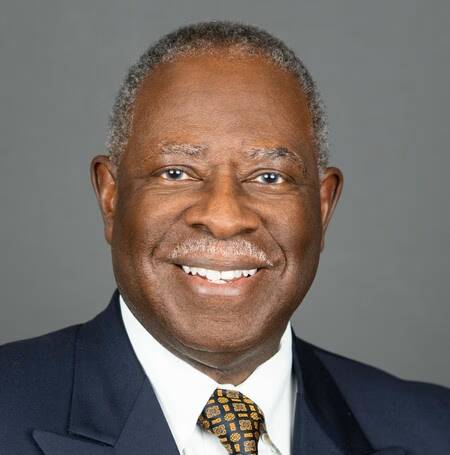
 Kevin Johnson, Black Equity & Humanity Fund cofounder, Cleveland philanthropist, and business consultant.In 2017, to preserve the aging tree at Rhodes High School, Holden Forests & Gardens and Cleveland Neighborhood Progress operations director Jeff Verespej worked with several neighborhood organizations, Bartlett Tree Experts, and Klyn Nurseries to use grafting techniques to grow sapling clones.
Grafting works by making cuts into a new branch of an existing tree with a separate root system, then binding their layers so they grow as a single plant.
“The continuation of the Jesse Owens Olympic Oaks through this grassroots community work is in honor of the enduring spirit of humanity and resilience that Owens represented, and a small contribution to the work of the Cleveland Black Equity and Humanity Fund,” Verespej said in a July 28 press release.
“The story represented in these trees starts in Cleveland's Old Brooklyn neighborhood but extends beyond generations to represent the best of what American ideals strive to be.”
About 20 saplings were auctioned before the CMA soiree. Proceeds will benefit the missions of Holden, the Black Equity and Humanity Fund, and the Jesse Owens Foundation, an informational resource and scholarship provider named after the Olympic champion.
Genetic descendants of the Rhodes High School English oak tree will ideally honor a man whose legacy still has room to grow, notes Johnson. Even his monumental victory abroad could not protect Owens from the realities of segregation, systemic racism, and a lack of economic opportunity at home.
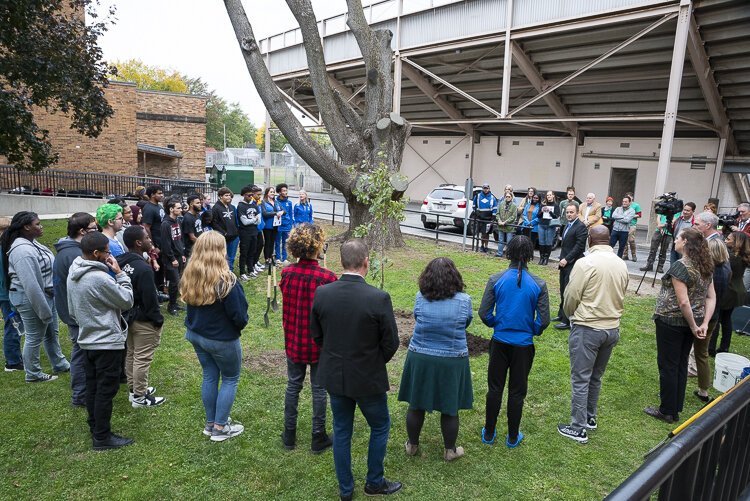 Jesse Owens tree sampling planting at James Ford Rhodes High SchoolAccording to Cleveland Historical—a project of the Center for Public History + Digital Humanities at Cleveland State University—Owens worked as a filling station attendant and playground supervisor in the years after Berlin. Although honored by a Cleveland parade, Owens described the contrast between grand public celebrations and scarce employment as “parades and poverty.”
Owens later established a dry cleaning business at East 100th Street and Cedar Road, though the enterprise shuttered after a few years. The former track star left Cleveland for good upon accepting a management job with the Ford Motor Company in Detroit. Owens eventually relocated to Chicago, where he died in 1980 at age 67.
Given his complex and storied history, Jesse Owens should be among the first names mentioned when discussing famous Clevelanders, says Johnson.
“Nobody had a bigger challenge than he had at the Olympics—this man had to basically face down fascism,” Johnson says. “The grace and dignity with how he performed and handled himself is a story for all people. This is not just about [Owens’] accomplishment, but the circumstances of those accomplishments.”
