
Nature's symphony: Cleveland's spring bird migration explained

Nature's symphony: Cleveland's spring bird migration explained
Mid-May marks an exciting time in Cleveland: It’s peak bird migration season. As warblers, thrushes, and other feathered travelers make their way north, the Audubon Society of Greater Cleveland is hosting a pair of spring online talks to help local bird lovers connect with the avian population passing through town.
Matt Valencic, master gardener and chair of the education committee for the Audubon Society of Greater Cleveland, will lead a free “Brown Bagging it in My Backyard: Spring Migration” webinar today, Wednesday, May 14 at 12 p.m., Valencic will talk about the birds passing through the region, how to identify them by sight and sound, and what makes this season so special.
Then, tomorrow, Thursday, May 15, from 7 p.m. to 8 p.m., longtime wildlife educator Harvey Webster will present “Save the World!,” a free virtual talk about how planting native trees, shrubs, and flowers can support biodiversity and create healthier habitats in our own backyards.
Both webinars can be accessed live and at the leisure of viewers after the events.
FreshWater Cleveland spoke with Webster, an Audubon Society of Greater Cleveland board member and former chief wildlife officer at the Cleveland Museum of Natural History, to learn more about birding in Cleveland, what to watch for this migration season, and how everyday efforts can make a difference.
FreshWater Cleveland (FW): What makes Cleveland such a special place for bird migration?
Harvey Webster (HW): There are literally billions of birds that take to the air every spring and every fall, and while some stay here year-round—blue jays, downy woodpeckers, cardinals, chickadees, tufted titmice—there are billions coming up from the south…the southern U.S., or they might be coming from southern South America.
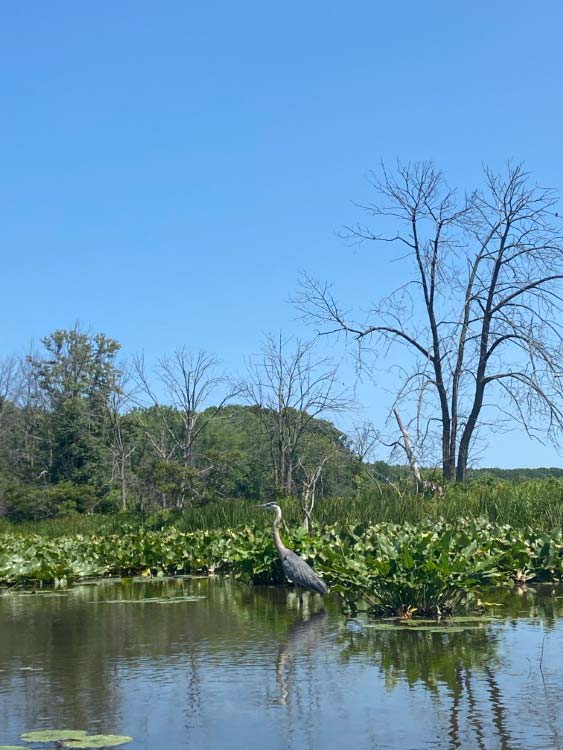
 For May bird watching, wildlife expert Harvey Webster recommends a morning visit to Mentor Marsh.What makes Cleveland so important is that we stand between two major migratory corridors—the Mississippi Flyway and the Atlantic Flyway. And if you think about birds migrating in great waves across the landscape, Lake Erie becomes a major impediment. Birds don’t want to fly over it unless they’re fully fueled.
So, these green spaces along the lakefront—Wendy Park, Cleveland Lakefront Nature Preserve, even Erie Street Cemetery right there by Progressive Field—become incredibly important staging areas. The concentration of birds in these places, especially in May, is just remarkable.
Note: In addition to Cleveland’s lakefront parks, Webster also recommends visiting Mentor Marsh, Magee Marsh, and Headlands Beach for some of the best birding opportunities in May. He says even small patches of green near the city, like cemeteries, backyards, or roadside woods, can be good spots for sightings.
FW: What kinds of birds are moving through right now?
HW: You’ll see yellow warblers in every bush and shrub, which have shown up in the last two weeks, and they’re here to nest in Ohio. But then we see lots of birds—Cape May warblers, parula warblers—they’re going to head much further north.
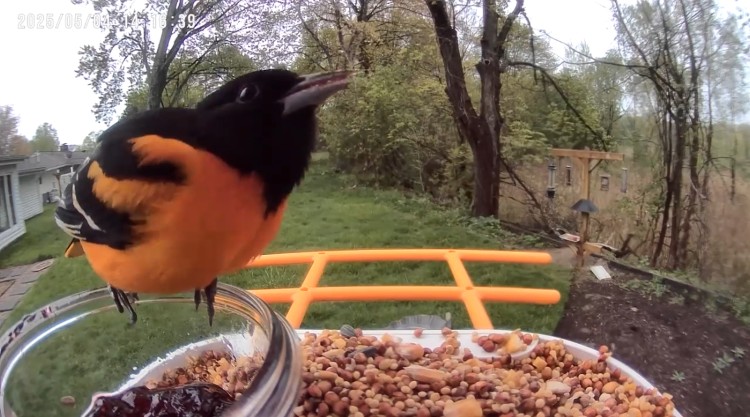
Baltimore orioles showed up about a week and a half ago. If you put out oranges or grape jelly, you might get one at your feeder. They’re going to nest in the neighborhood.
My wife, daughter, and I went birding just yesterday and saw 85 species in one day. We also missed a big one by just a day—a Kirtland’s warbler was spotted at Magee Marsh. That’s a big deal. The bird winters in the Bahamas and nests almost exclusively in central Michigan, in young jack pine forests.
There are probably only 5,000 or 6,000 [Kirtland’s warblers] in the world. And when one shows up in Ohio, word spreads fast—social media lit up, and everyone rushed in to see it.
FW: How long does spring migration last?
HW: The first three weeks of May are really the high point of spring migration. By late May, early June, it is petering out. And actually, by the time you get to July, the fall migration has already started, because there are some shorebirds, some sandpipers that get to the north, they breed in tundra areas.
The males are kind of deadbeat dads. As soon as they’ve established territory, gotten a mate, and gotten on, then they take off and head south. They might appear back in Ohio as early as July.
FW: Why should people care about migrating birds and the habitats they rely on?
HW: I think number one, entirely out of self-interest. It’s been widely documented now that getting out in nature, communing with nature, and enjoying birding or bird watching is just a wonderful, non-consumptive use of wildlife and wild places. It’s restorative. It lowers your blood pressure. It’s great for kids, for learning, for ADHD—I mean, you name it.
There’s something about birds—the variety of shapes and colors, and song. We humans tend to be creatures of vision and sound, and the birds are very much operating in our primary sensory dimensions.
 A migrant Baltimore oriole visits the backyard birdfeeder at the home of FreshWater’s social media guru, Alyssa BrosiousBut the other thing is that birds, in their diversity, are adapted to a wide variety of habitats and ecosystems. And their population’s health is reflective of the health of the environment. And we should be very mindful of that, because if you start seeing declines, then that calls into question, what are we doing wrong in the environment? That’s going to be a subject of the program I’m doing Thursday evening.
In the same period of time that we’ve engineered tremendous conservation success stories with peregrine falcons, ospreys, bald eagles, trumpeter swans, and many waterfowl and raptors, we’ve lost about 29% of all birds in North America since 1970. And that’s a stunning number. That represents billions and billions of birds. So clearly, even though we’re doing a lot, we’re not doing enough.
FW: What tips do you have for spotting birds in the wild, or following migration updates?
HW: If you do get out in the marsh or in the woods at dawn in May, generally you just hear an amazing—not a cacophony, but a symphony—of bird songs. As everybody's vying for it, they're kind of carving out their unique sonic niche.
We encourage all birders to use something called eBird, which Cornell University makes available for free. It’s kind of like an online checklist. Once you download it to your phone, you log your birding location and the species and numbers you observed.
They’ve merged that data with Doppler radar, and now they have something called BirdCast. It actually gives you a prediction on how many birds they anticipate will be migrating over your location tonight based on the weather, the season, and this mountain of data they’ve accumulated over the years.
FW: What’s your advice for backyard bird watchers or feeder cam users?
HW: Bird feeders are great, don’t get me wrong, but it’s kind of like fast food. If somebody thinks, “Well, what would the birds do if I didn’t feed them?” They’d be just fine. They’re going to find natural sources of food. But if you’re going to make it easy for them, they’re going to take advantage of that.
An important part of actually laying out the banquet table, in a much more effective way than just putting up bird feeders, is to have the habitats that feed them naturally.
If you plant goldenrod or other native species, you’re creating real food. Goldenrod galls, for example—those round swellings on the stems—contain wasp larvae, and woodpeckers love them. Downy woodpeckers go after those things all winter.
And chickadees, for instance, raising a brood, need thousands and thousands of caterpillars. Not sunflower seeds—caterpillars. It’s those high-fat, high-protein caterpillars that they’re raising their family on.
So, if your yard has native plants that support those insects, you’re giving birds what they actually need to reproduce. If you don’t have plants that are food for the caterpillars, then suddenly this potential breeding bird can’t find the resources it needs in your yard.
FW: Is it true that a water source can be more beneficial for birds than a feeder?
HW: Yes. If you have water, even static water, just make sure you change it daily. Standing water becomes a breeding site for mosquitoes. But if you can add movement—a little recirculating pump or trickling water—that’s ideal. Birds are naturally drawn to the sound, and it attracts both local residents and migrants.
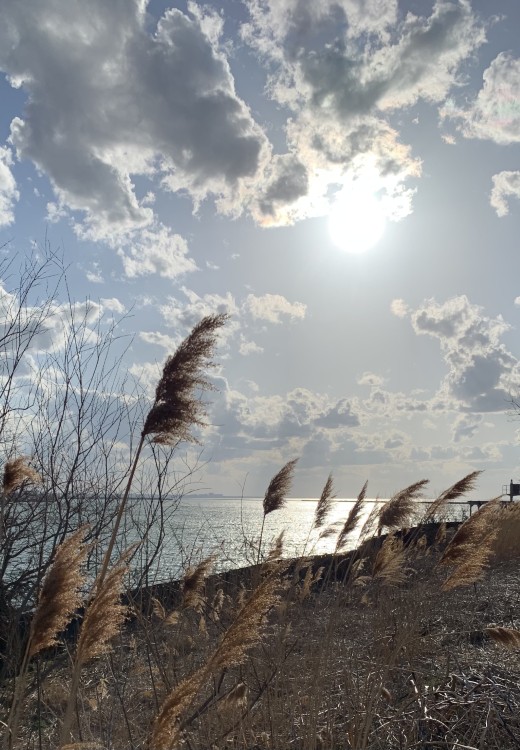
 Pocket habitats along Lake Erie's shores, like the Cleveland Lakefront Nature Preserve, become important stopover sites for migrant birds to refuel before heading north.And it’s not just for drinking—it’s for bathing. Birds bathe in both water and dust to help with feather maintenance… Feathers are everything—they insulate, protect, and keep a bird airborne. Most birds have a gland above the tail that produces a waxy oil. After bathing, they preen their feathers with it to condition and waterproof them.
They spend a lot of their waking hours taking care of their feathers. For most birds, those flight feathers have to last an entire year.
FW: What are the biggest threats birds face—and what can people do at home to help?
HW: One of the biggest is glass. Birds see reflections of trees or sky and don’t realize it’s a barrier—it’s like solid air—and they strike the building. Bright lights at night draw birds into the city, and by dawn, they make landfall at places like Public Square or The Mall. But now they’re surrounded by buildings with plate glass windows.
But it’s not just skyscrapers. If you’ve got big glass doors or windows at home and you’re seeing dead birds on your patio, you’re part of the problem. But it’s fixable. You can apply dots, strings—something that helps birds see the glass.
Another big one is cats. Even well-fed house cats are a major cause of bird mortality—some estimates run as high as a billion birds killed each year in the U.S. by house cats. And they’re not hunting because they’re hungry. A lot of the time, they lay the bird at your feet. It’s just a total waste.
There’s a lot people can do to help. If your yard is all lawn and invasive plants, it’s not supporting anything native. But if you start planting native species—maybe take half your yard—you’re doing something. And when your neighbors see it and want to do it too, you start creating corridors of habitat that actually matter.
It’s like your vote in a democracy. It may not seem like much, but it’s both your right and your responsibility. And if enough of us act, it adds up to real change. We are not apart from nature—we are a part of nature. And the fate of the natural world is in our hands.
FW: Is there a particular bird or migration story that really sticks with you?
HW: I think about the blackpoll warbler—a tiny bird, weighs about the same as a ballpoint pen. They nest way up north, as far as Nome, Alaska.
In late summer, instead of flying south, they fly east-southeast to the Atlantic coast, bunching up from Hatteras to New England. There, they fatten up—kind of doing a bird version of a sumo wrestler—on bugs and put on brown fat for fuel.
They wait for a low-pressure system. When the winds shift to north-northwest, they launch—not over land, but over the open Atlantic. They climb to 2,000–5,000 feet and flap southeast until they hit the trade winds, which guide them down to Venezuela.
They make that flight—nonstop—for 88 hours. And by the time they land, they’ve burned everything but their brain, heart, and flight muscles.
They winter in the tropics, then island-hop back through the Caribbean and pass through Ohio in May.
It’s just a marvel—of evolution, orientation, navigation, and sheer stamina. And when you see one of those birds smashed into a plate-glass window in downtown Cleveland, it kind of breaks your heart. That bird, by being here in springtime, made that Atlantic crossing.
That’s why it’s so important that we not only preserve habitat but make the migratory routes as obstacle-free as we possibly can.
For more birding resources, at-home habitat advice, tips on planting native species, and to watch archived talks, visit clevelandaudubon.org and naturemybackyard.clevelandaudubon.org.
