From fire to higher ground: Rescued Tiffany window finds new life in Hudson





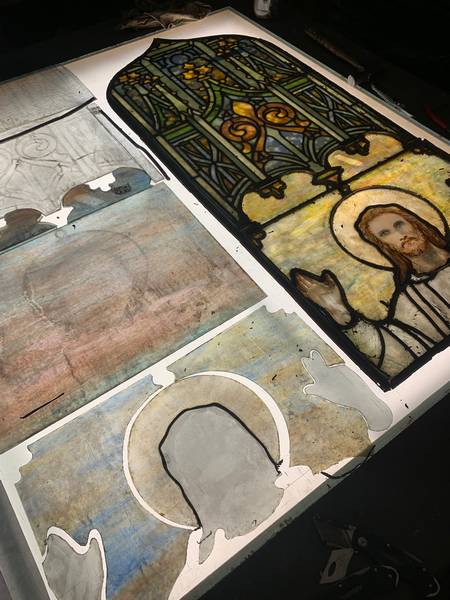

 Tiffany Window Detail.A 109-year-old Tiffany stained-glass window has already survived a lot.
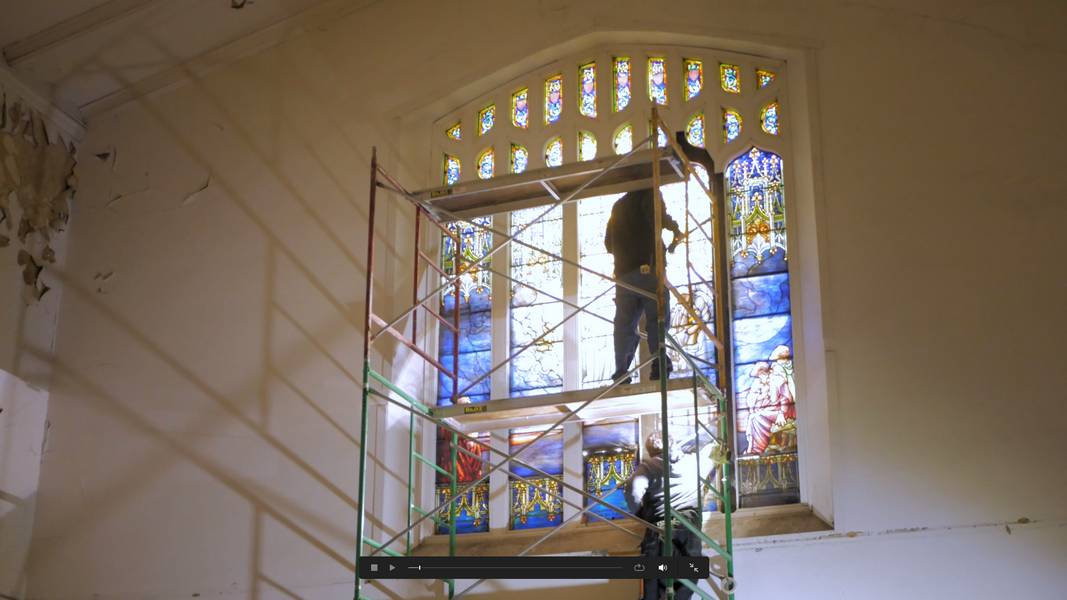
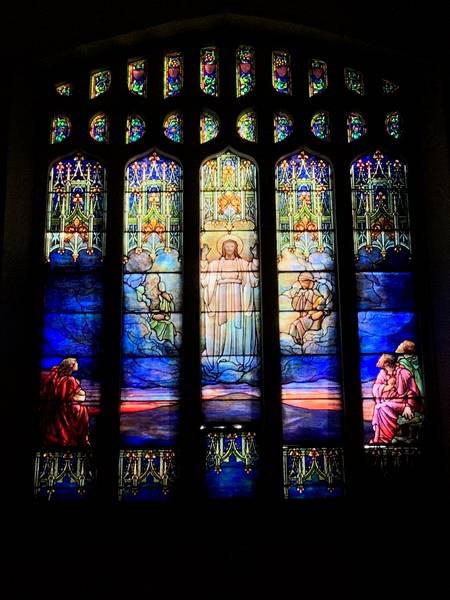
The window was created in 1917 for St. Paul’s Episcopal Church in Akron, where it remained for more than a century. It survived a 2018 fire that tore through the historic church.
Then, piece by piece, it was carefully removed, transported to Cleveland and meticulously restored.
Now the enormous window—14 feet tall and 11 feet wide—is beginning another chapter.
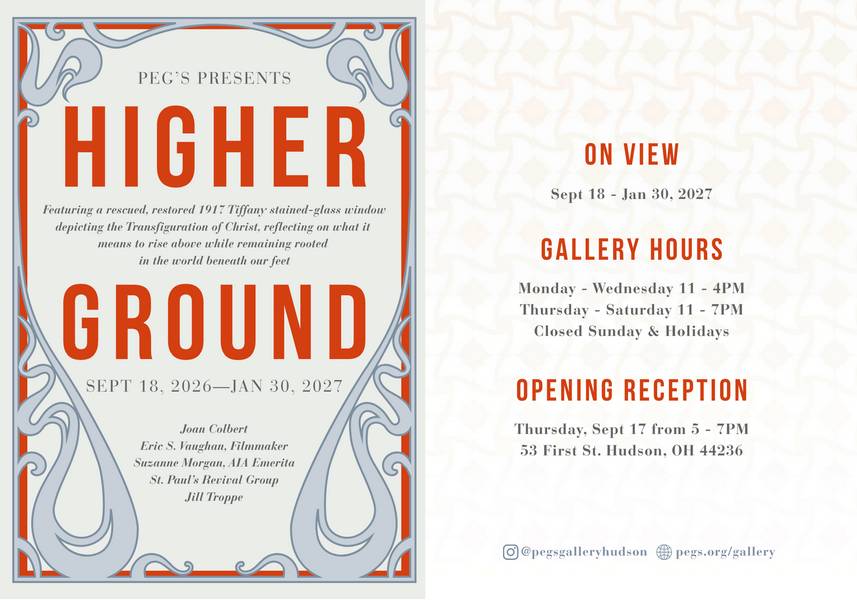
The restored work is the centerpiece of a new exhibit, “Higher Ground,” opening to the public on Friday, Sept. 18 at Peg’s Gallery, a Hudson philanthropic organization dedicated to improving the lives of people with serious mental illness.
A public opening reception will take place from 5 to 7 p.m. Thursday, Sept. 17.
“Higher Ground” brings together works by Northeast Ohio artists and creators exploring resilience, recovery, transformation, and new beginnings.
“It is definitely a Tiffany,” says Courtney Cable, director of arts and campus programs at Peg’s Foundation & Gallery, of the window. “There are several signature panels, which have been inscribed on those panes of glass.”
Visitors can see two of those signature panels on the lower right side of the installation, identifying Tiffany Stained Glass Studio in New York as its creator.
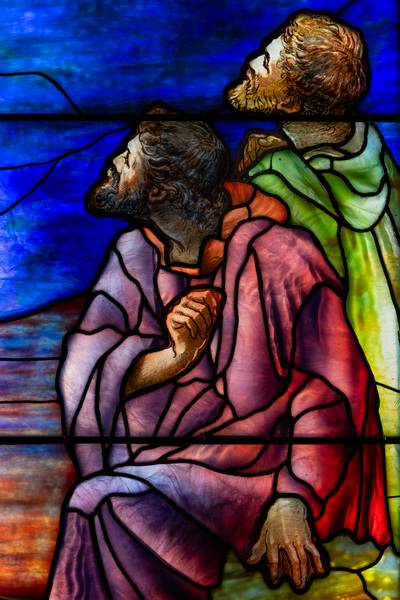
The window depicts the Transfiguration of Christ, with the apostles ascending a mountain and witnessing Christ above them. That imagery helped inspire the exhibit’s title.
“Higher Ground” also reflects the journey the window itself has taken—from its original sacred space, through fire and restoration, to its new home in a gallery.
 Chimney Swifts in Studio.A window worth saving
St. Paul’s Church, located on Market Street in Akron, was built in the late 19th century and was an important early church in the city. The Tiffany window was commissioned by the granddaughter of Akron founder Col. Simon Perkins and installed in 1917.
When fire swept through the building in 2018, the window did not come in direct contact with the flames but suffered smoke damage.
Akron preservationist Tony Troppe and members of the St. Paul’s Revival Group worked with supporters of historic preservation to save it. Whitney Stained Glass Studio in Cleveland was brought in to carefully remove the window, panel by panel.
The restoration found that the window had held up remarkably well. Cable says only one piece of glass was missing and needed to be replaced.
Its condition was due in part to years of careful preservation. While the window was in the care of the University of Akron, a maintenance worker recognized the need to protect it from deterioration, adding extra plexiglass and support.
“That person had the foresight to protect this piece over time,” Cable says, adding that the craftsmanship can now be appreciated from a completely different perspective.
A new light
At Peg’s Gallery, natural light passes through the window as it was originally intended to do in the church.
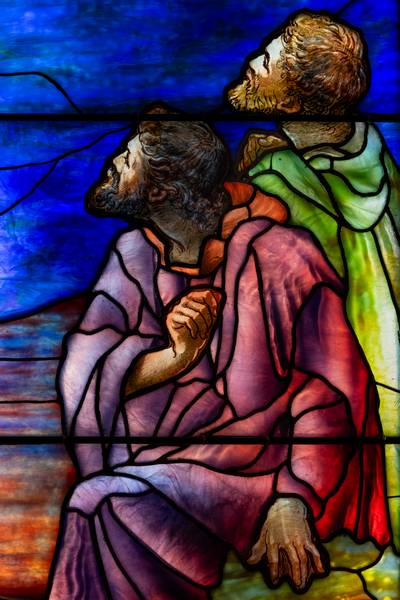
 Tiffany detail.Up close, visitors can see the intricate craftsmanship, including glass that has been bubbled and bent to create texture and depth in the drapery of the figures’ clothing. Some sections contain as many as eight layers of glass, creating additional depth and darkness.
From farther away, the effect changes.
The darker edges draw the eye toward the center, where opalescent glass catches the light. Lamps at the top of the window appear to glow.
“It looks like an oil lamp that is actually glowing,” Cable says.
The open floor plan of Peg’s Gallery allows visitors to experience both views—moving close enough to study the craftsmanship before stepping back to take in the entire composition.
A new documentary by filmmaker Eric S. Vaughan, “The Luminaires,” presents another perspective on the window’s journey. The documentary follows the rescue, restoration, and reemergence of the Tiffany window, including footage of the church after the fire and the effort to save what remained.
The film will premiere as part of the exhibit.
Beyond the window
The other works in “Higher Ground” were selected to build on the themes found in the window.
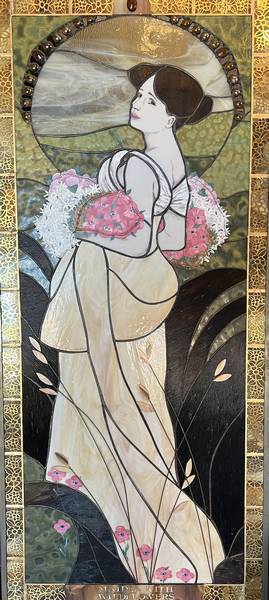
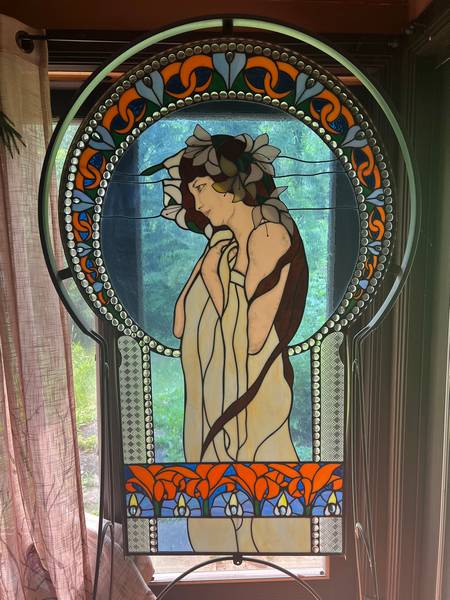
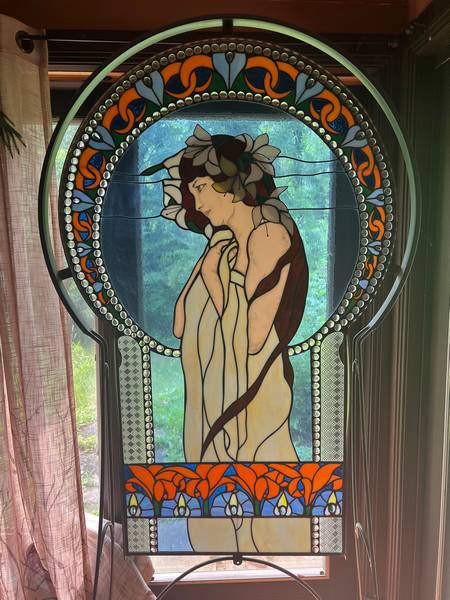 Mucha Maiden.Stained-glass artist Jill Troppe brings Art Nouveau-inspired works featuring elegant maiden figures and botanical motifs. Troppe’s work has its own Northeast Ohio connection: She drew inspiration from research into the historic Everett Building in downtown Akron and illustrations by renowned Art Nouveau artist Alphonse Mucha.
Troppe also found a connection to Peg’s itself through the dogwood flower featured in the foundation’s logo. She recently returned to her studio practice after spending years focused on motherhood and business.
“She was really inspired by the dogwood flower, which is the logo of Peg’s Foundation,” Cable says. Troppe’s existing vases have already sold out, but she is creating a new piece for the exhibit—a chalice that may incorporate a dogwood flower.
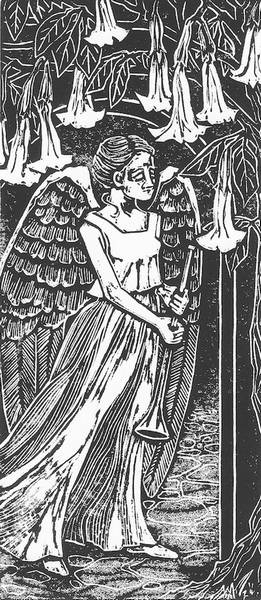
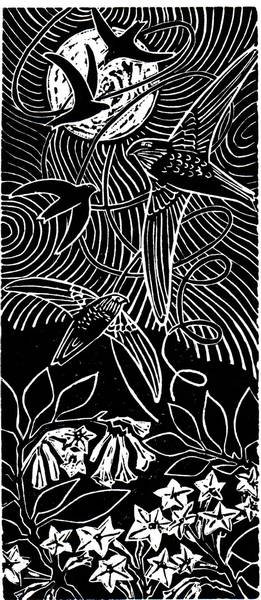
Akron artist Joan Colbert brings black-and-white linocut prints featuring plants and birds, including chimney swifts. The birds spend much of their lives in flight—a playful connection to the exhibit’s idea of defying gravity.
“They never land on the ground, and so they’re only living in the sky,” Cable says.
Four architectural models by architect Suzanne Morgan, AIA Emerita, add another dimension to “Higher Ground.” The models represent sacred spaces from different faith traditions and were part of a larger series of nine models that had been displayed in Chicago for two decades.
One of the models represents a Frank Lloyd Wright-designed building.
The architectural models also echo the design of Peg’s own headquarters and gallery in downtown Hudson, which incorporates sandstone, wood and other materials as a nod to the city’s appreciation for historic architecture.
Together, the pieces create a conversation about sacred spaces, nature, craftsmanship, light and transformation.
Cable adds that these artists’ works don’t have to be directly about mental illness to have a place at Peg’s.
A different kind of space
The mission of Peg’s Foundation is to improve the lives of people with serious mental illness, and the gallery is one way foundation officials hope to create an entry point for people to learn more about the mission while simply enjoying art.
“We believe that the art gallery is a portal in which people can learn more about serious mental illness,” Cable says, “while still enjoying an art show, an art exhibit, an art experience.”
 Tiffany Window Detail.That distinction is important to Peg’s, Cable says, emphasizing that not every exhibit needs to feature artists with serious mental illness or directly address mental health.
Instead, the gallery offers a welcoming space for people to step into a different conversation.
That idea resonates particularly strongly with “Higher Ground.”
The window’s story of damage, preservation, restoration, and a new purpose represents the broader themes of “Higher Ground” without requiring visitors to approach the artwork through a mental-health lens.
“Which is why we wanted a lighter space like this—an art space,” Cable says, “for people to take their mind off of things, go in and enjoy themselves, have a different conversation in their mind, [with] different topics.”
For Peg’s, that is part of the point.
For visitors coming to see “Higher Ground,” the invitation is simpler: See the window.
Cable recommends visitors stand close enough to see its layers of glass and intricate details.
Then step back and watch the light change it.
After surviving a century, a church fire, and a complete restoration, the Tiffany window has found a new place to tell its story.
And this time, it has a little higher ground.
“Higher Ground” opens with a public reception Thursday, Sept. 17, from 5 p.m. to 7 p.m., at Peg’s Gallery, 53 First St. in Hudson. Admission is free. The exhibit runs through Jan. 30, 2027.
Gallery hours are 11 a.m. to 4 p.m. Monday through Wednesday and 11 a.m. to 7 p.m. Thursday through Saturday.